
Last updated November 2, 2026
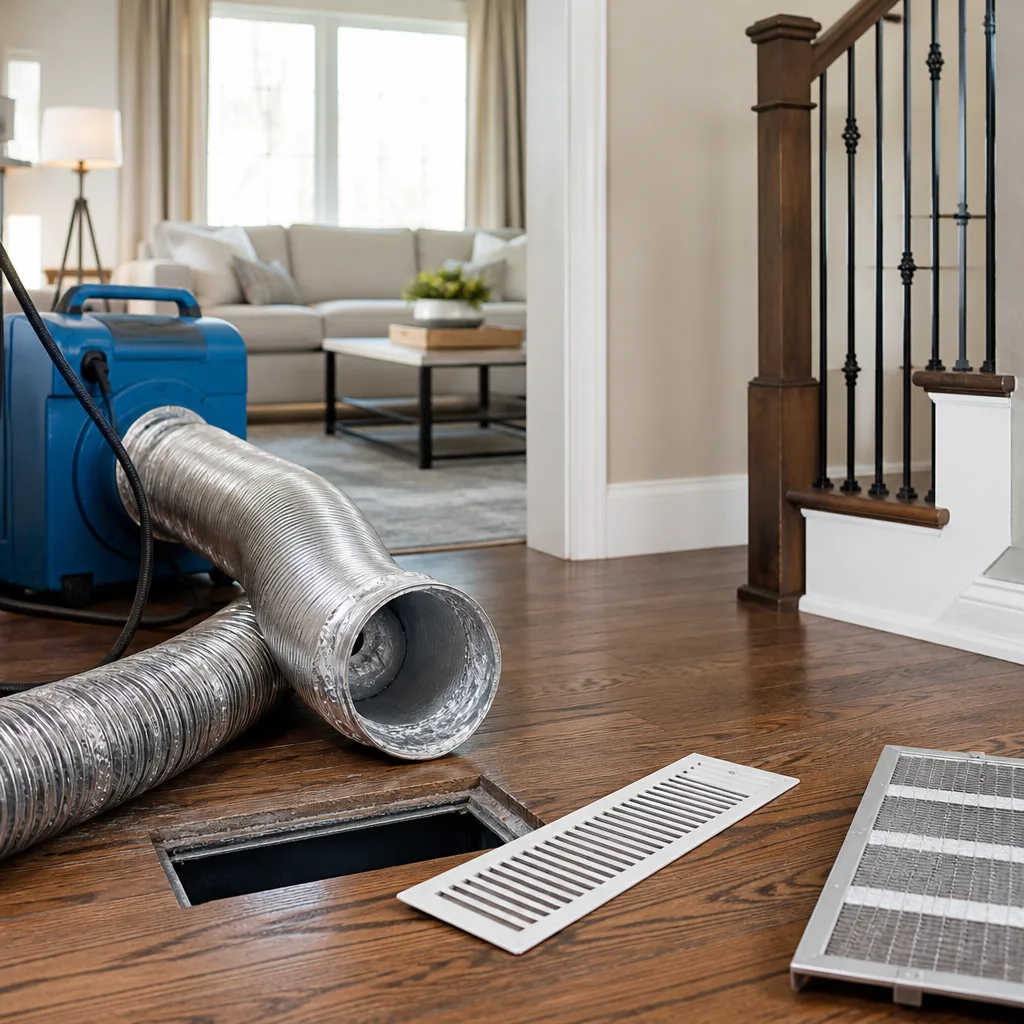 Whole-home duct cleaning
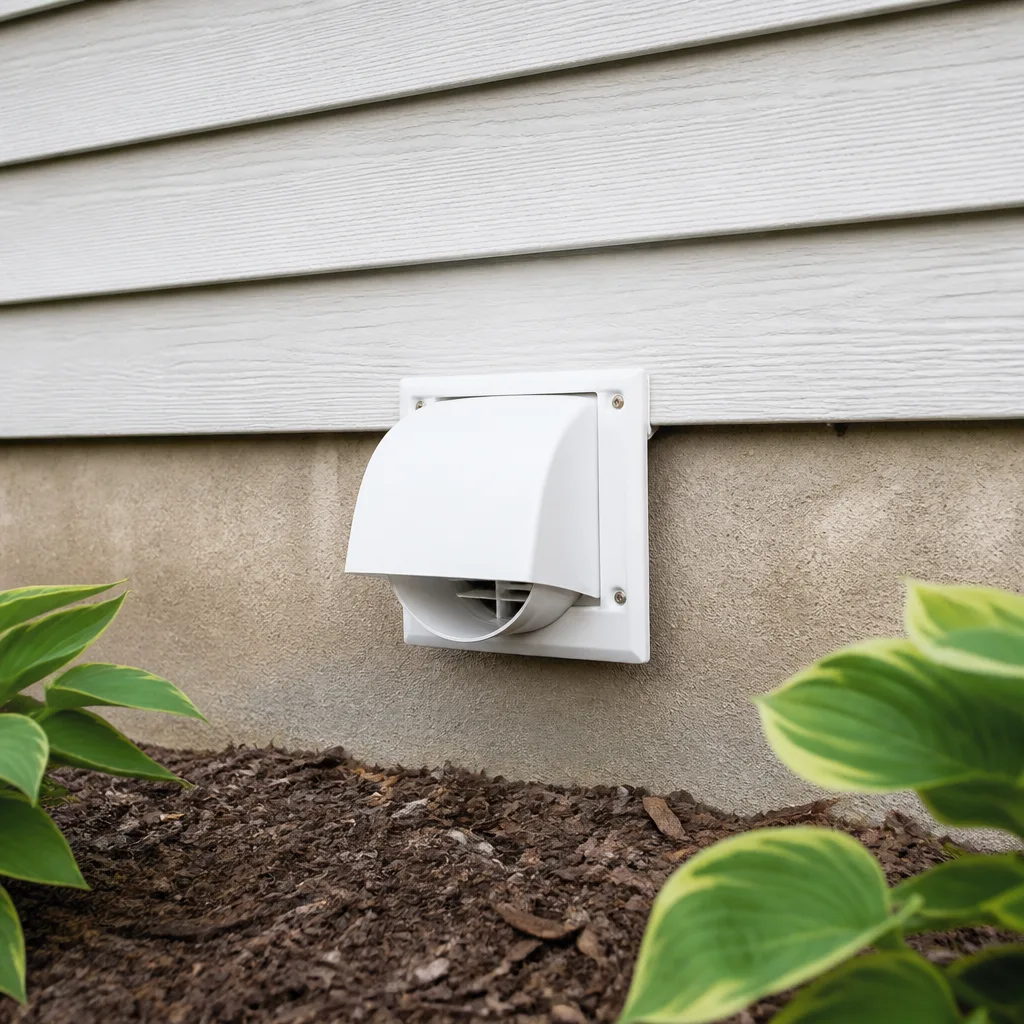 Dryer vent cleaning
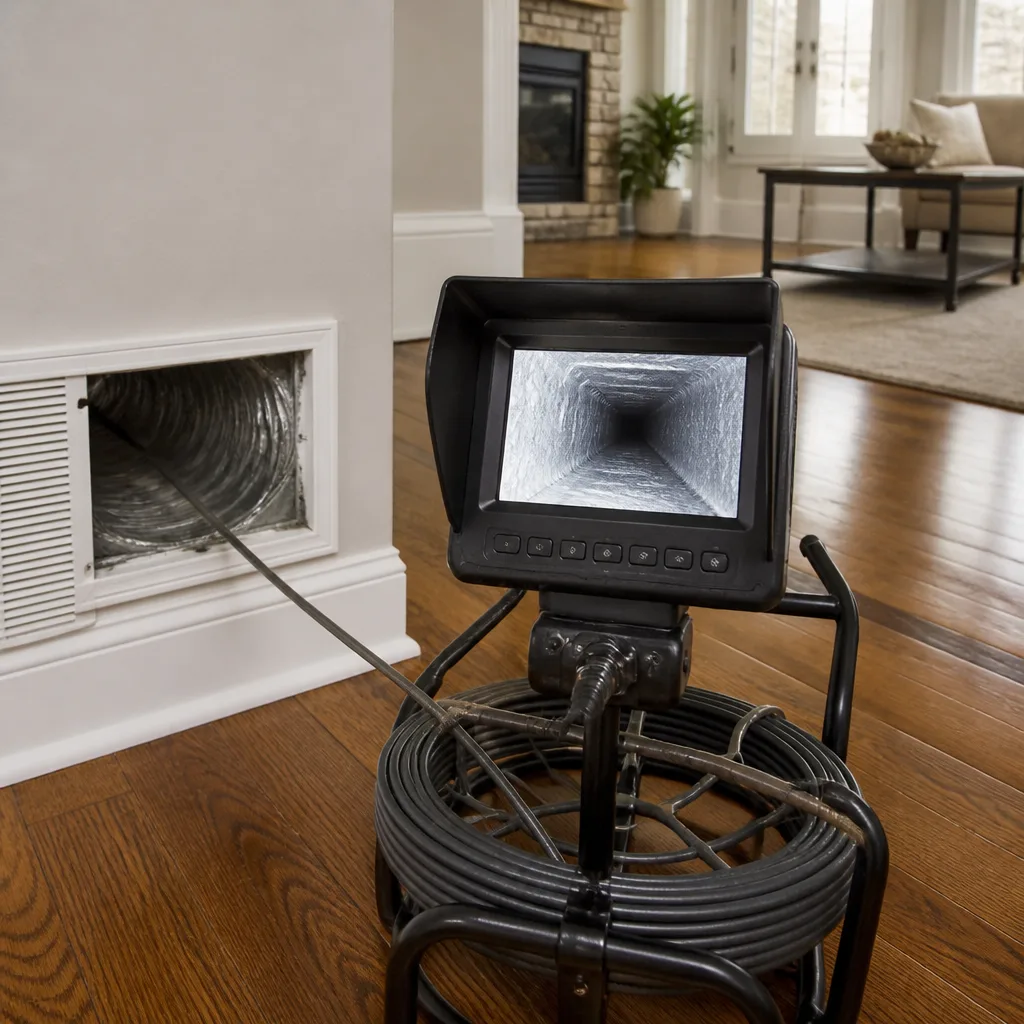 Camera inspection
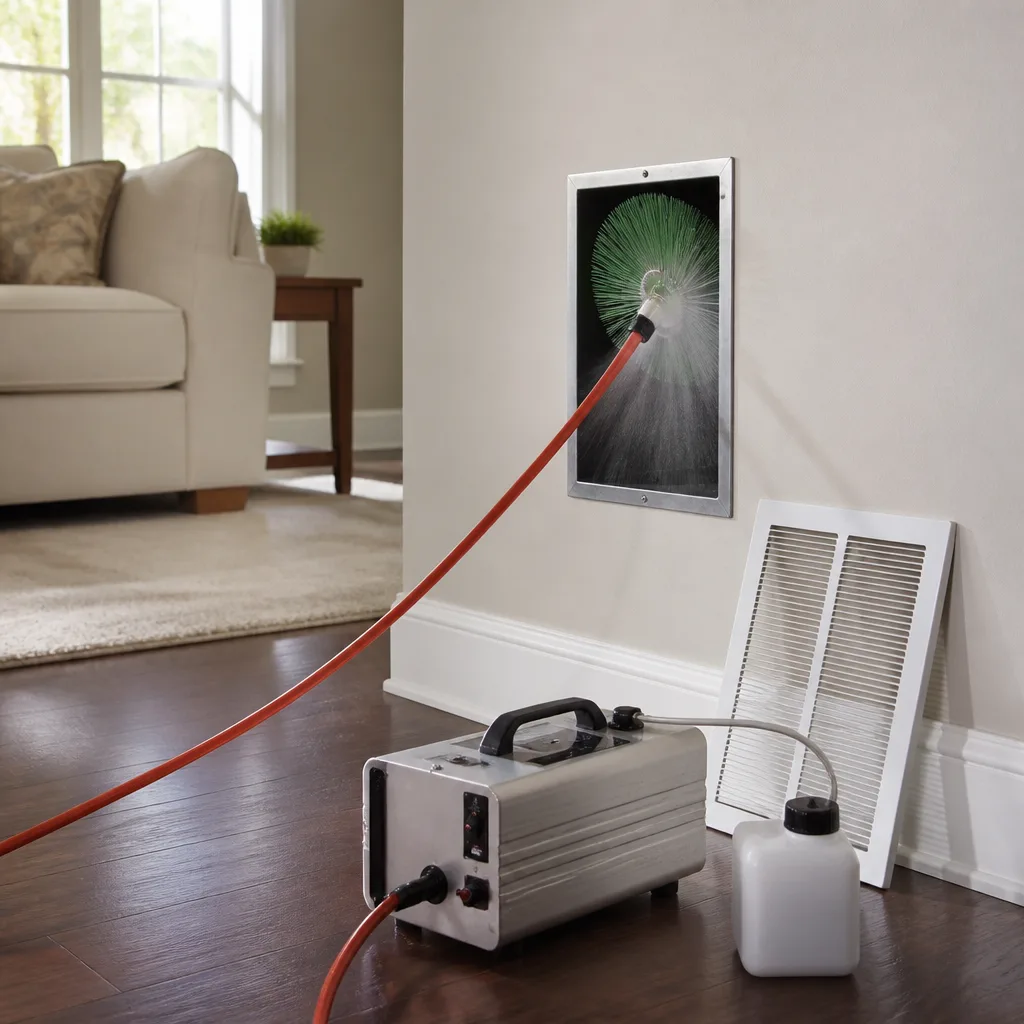 Sanitizing & deodorizing
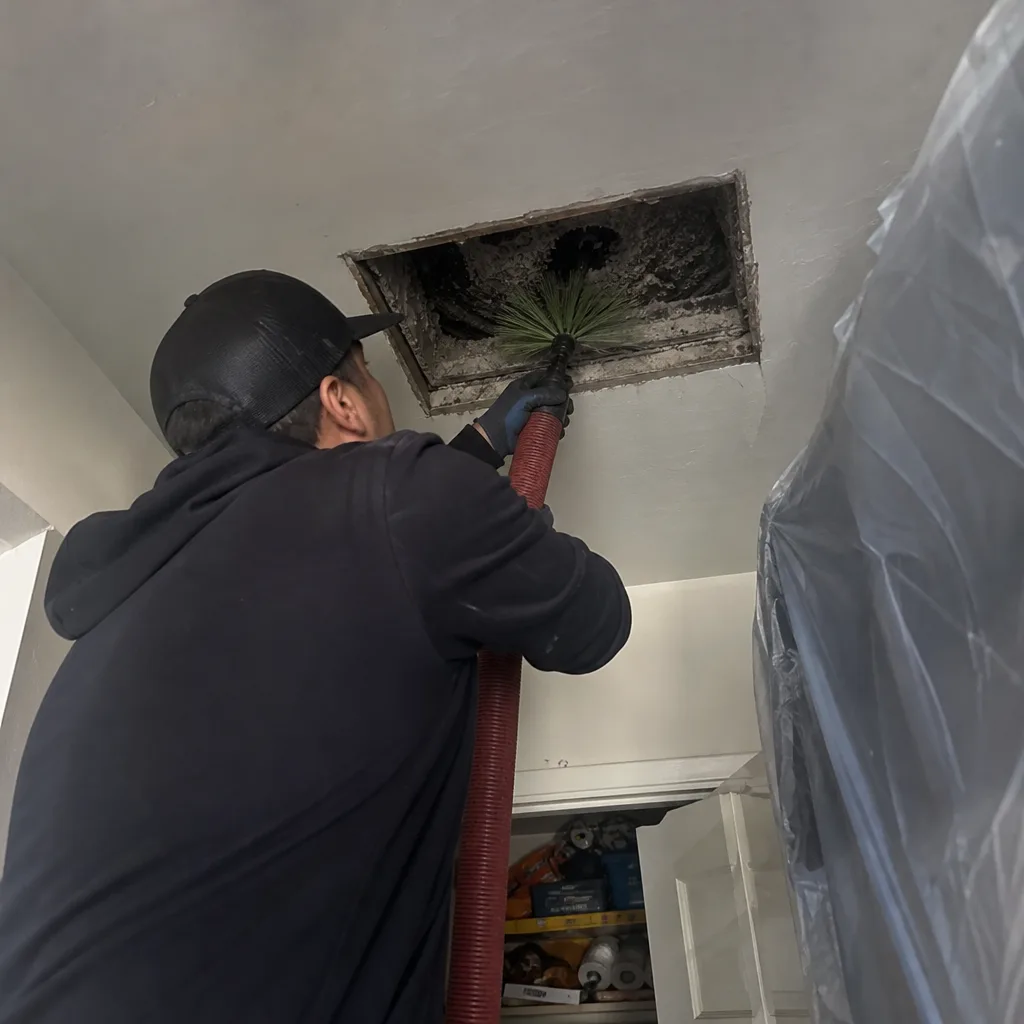
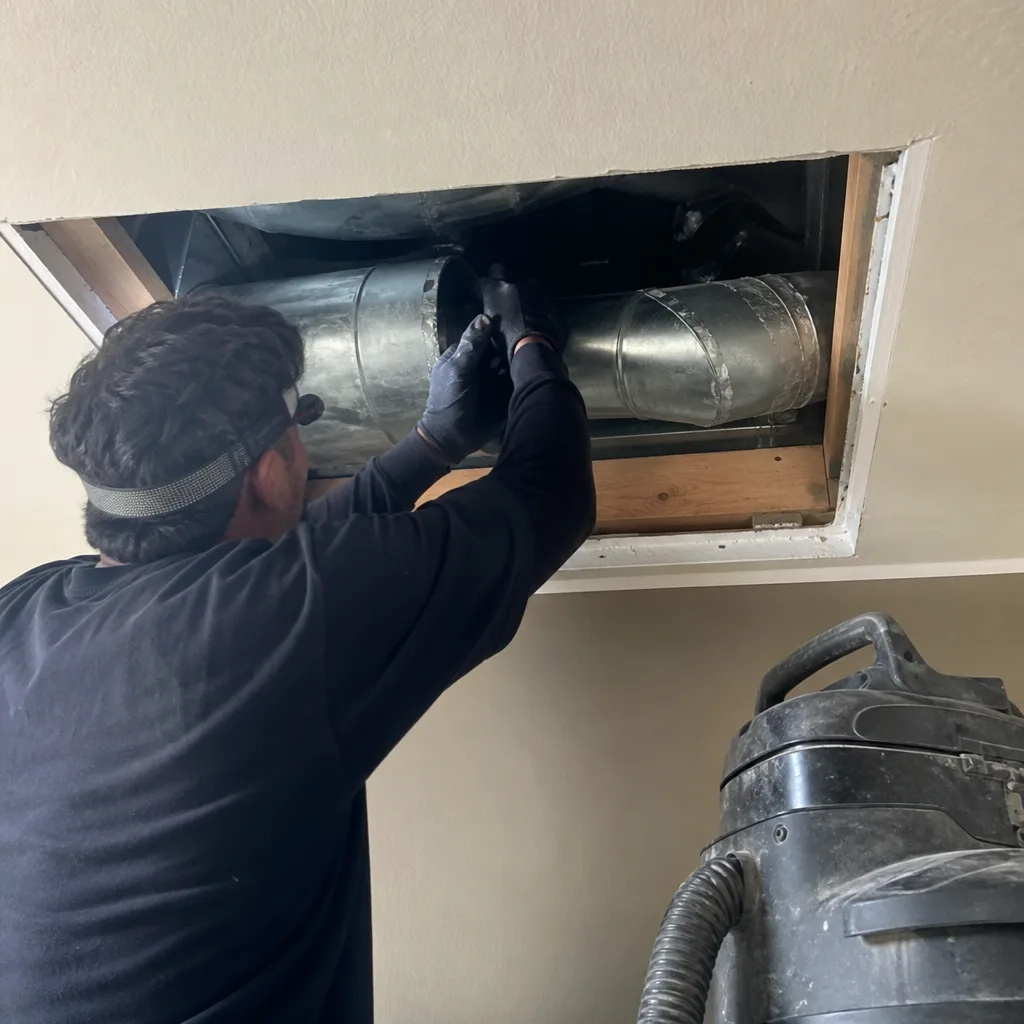
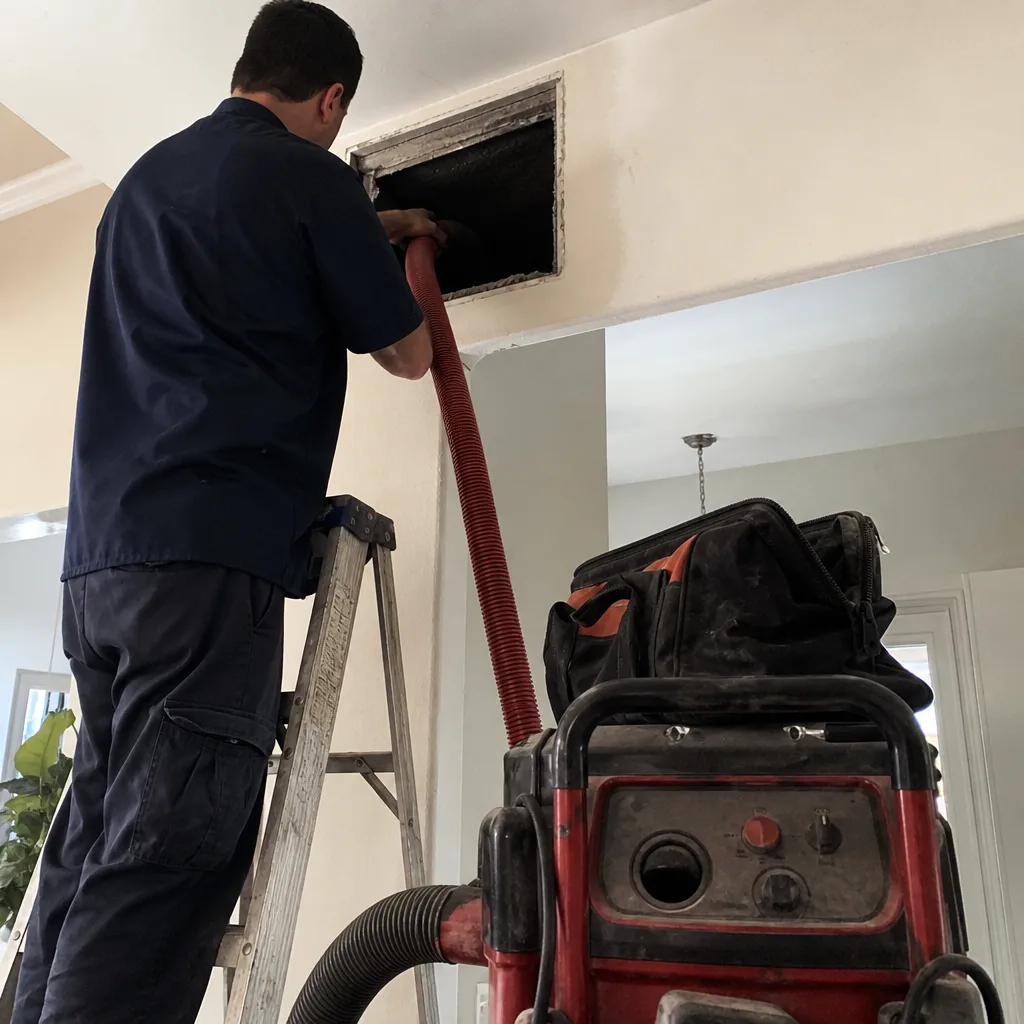
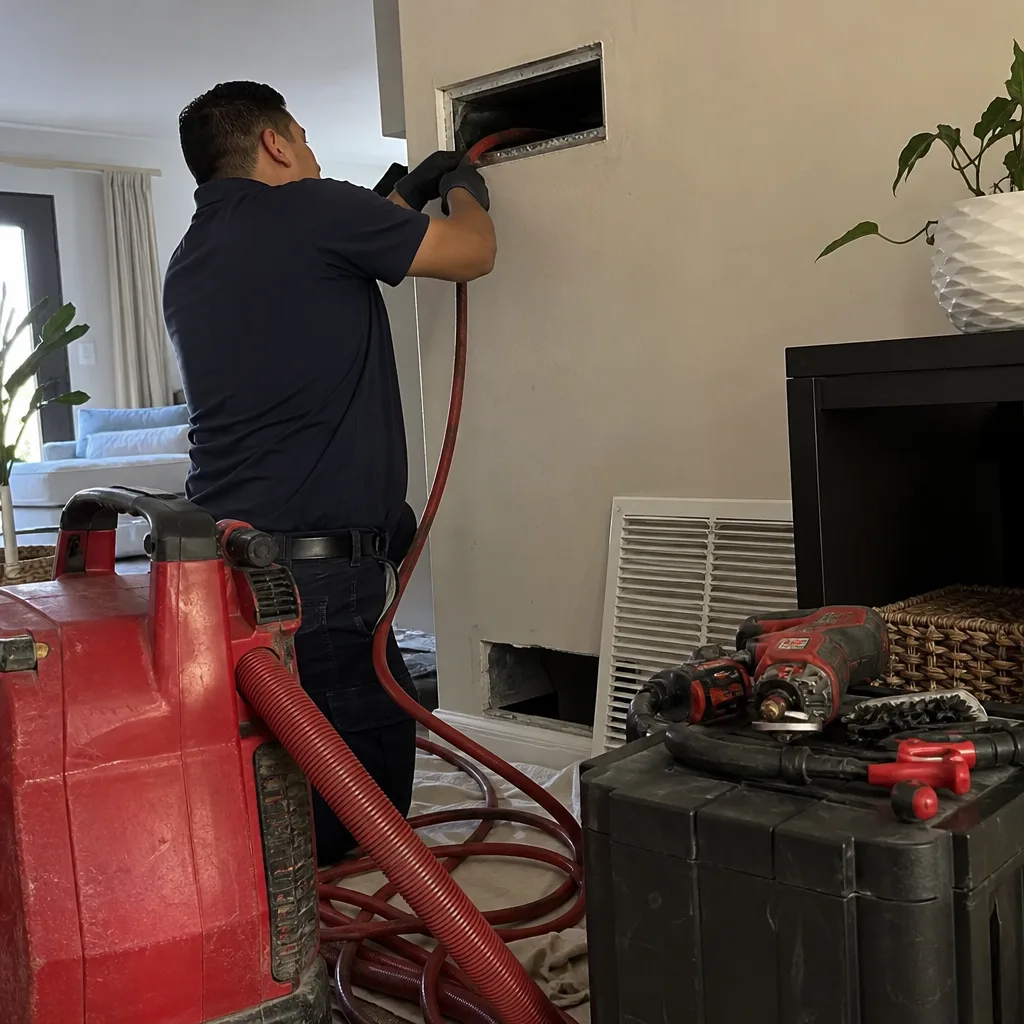
Whole-system duct and dryer vent check with before-and-after photos - you see exactly what came out of your vents
That "$99 whole-house special" is a bait ad - the real number appears once they are in your hallway, or the "clean" is a shop-vac at the register. We photograph the inside of your ducts before and after instead.
Air Duct Cleaning Warning Signs: A Tustin Homeowner’s Reference Guide
If your HVAC technician has checked your system twice in two years and can’t explain why two rooms won’t cool properly, there’s a 60% chance the answer is in the ducts, not the equipment. That’s not a number pulled from a marketing brochure. It reflects what we see across Tustin homes week after week: air handlers running fine, coils clean, refrigerant levels normal, yet airflow to specific rooms remains weak, temperatures stay uneven, and dust keeps settling on furniture within days of cleaning. This guide walks through the warning signs most homeowners misattribute to their HVAC unit, how to tell a duct problem from an equipment problem before spending money on a service call, and when the right response is professional air duct cleaning rather than another condenser inspection.
Styles & brands we work with
- Whole-home duct cleaning
- Dryer vent cleaning
- Camera inspection
- Sanitizing & deodorizing
Quick Answer
The clearest warning signs your ducts need professional cleaning in Tustin are persistent dust accumulation within 48 hours of cleaning, weak or uneven airflow from specific registers, a musty odor that returns after filter changes, and visible debris at multiple registers. If you’ve already had your HVAC equipment inspected and no mechanical fault was found, the duct system is the next and most likely culprit.
Table of Contents
- Airflow Signals You Can Measure Yourself
- Odor Profiles: Musty, Burning, and Chemical Smells Decoded
- Dust Patterns and What They Reveal About Duct Contamination
- The Filter Timeline: What Loading Speed Tells You
- Post-Renovation and Post-Pest Warning Signs in Older Tustin Homes
- What Visible Debris at Registers Actually Indicates About What’s Deeper
- How to Distinguish HVAC Equipment Failure from Duct Contamination
- Common Mistakes to Avoid
- When to Call a Professional
- Frequently Asked Questions
- The Bottom Line
Airflow Signals You Can Measure Yourself
Before you call anyone, spend ten minutes walking your home with a simple method: hold your hand two inches from each supply register while the system runs. Pay attention to the force of air, not just whether air is moving. In a healthy duct system, every register in a given zone should produce roughly similar airflow. Rooms furthest from the air handler will naturally be slightly weaker, but the difference should be modest, maybe 15 to 20 percent at most. When one bedroom feels like a stiff breeze and another feels like a faint exhale, the problem is rarely the blower motor. It’s almost always a restriction or leak somewhere in the duct run serving that room.
Tustin’s housing stock spans several decades, and we see this pattern frequently in older neighborhoods where original ductwork has been in place since the home was built. A room-to-room temperature variance of more than 8 degrees Fahrenheit during peak cooling season is a strong indicator of duct restriction, especially when both rooms share the same thermostat and neither has unusual sun exposure. Measure this with an inexpensive infrared thermometer aimed at the register grille itself, not the room air. Two rooms, same system, eight-plus degrees apart, and an HVAC inspection that found nothing mechanically wrong: that combination points directly at the ducts.
Static pressure indicators from filter loading offer another measurable clue. When a filter loads with dust faster than its rated service interval, say a one-inch filter that looks clogged after three weeks instead of the typical ninety days, the ducts are feeding that filter more particulate than a clean system should. One way to confirm this is to compare filter loading speed across seasons. If you’re changing filters dramatically more often during spring and fall, when windows are open and Tustin’s Santa Ana winds push dust into attics and crawl spaces, the duct system is ingesting and circulating that particulate. For more detail on what a proper cleaning involves, see our guide to Air Duct Cleaning in Tustin.
Odor Profiles: Musty, Burning, and Chemical Smells Decoded
Odors are the second most common warning sign, but they’re also the most misread. Each odor profile points in a different direction, and treating them all as “dirty ducts” leads to wasted money. Here’s what each profile indicates, based on what we encounter in Tustin homes.
Musty or earthy odor: This is the classic duct contamination smell. It’s strongest when the blower first kicks on and fades as air continues to flow. In most cases, it indicates accumulated dust and organic material inside the return or supply plenum that has absorbed moisture. In Tustin’s semi-arid climate, that moisture usually comes from two sources: condensation on poorly insulated duct surfaces during humid late-summer nights, or a slow leak from a swamp cooler or evaporative system in older homes. A musty smell that persists after filter replacement and does not improve with filter upgrades points strongly to material lodged inside the ducts themselves.
Burning or dusty-campfire odor: This smell almost always appears in fall when the heating cycle starts for the first time in months. As the heat exchanger warms the air, accumulated dust on internal surfaces burns off. A brief dusty smell on the first heating cycle of the season is normal, even in clean systems. But if the burning smell lasts more than a few hours of total run time, or returns every time the system heats, the volume of accumulated material inside the ducts exceeds what normal burn-off clears. Call a professional. A persistent burning smell combined with reduced airflow can also indicate that something is physically lodged against a heating element. In our experience, this is one of the warning signs that demands immediate attention, not monitoring.
Chemical or solvent odor: Unlike musty or burning smells, a chemical odor that appears only when the system runs and disappears when it stops is a serious red flag. It can indicate refrigerant leaking into the air stream, or materials stored near return vents off-gassing and being pulled through the system. If you smell something chemical and you’ve had recent renovation work, HVAC adhesive work, pest treatment, or stored cleaning products near a return intake, shut the system off and have it inspected. This is one of the few odor profiles where the HVAC unit itself, not the ducts, may be the source. For that reason, it’s worth ruling out an equipment leak before assuming the ducts are the problem. If the ducts do turn out to be the source of a persistent contamination issue, we can often address it same-visit alongside Air Duct Repair in Tustin.
Dust Patterns and What They Reveal About Duct Contamination
Every home produces dust. The question is where that dust comes from and where it settles. Duct contamination produces a very specific dust pattern, and once you know what to look for, it’s hard to miss.
- Dust accumulations on supply register louvers. The grille itself is the first place dust shows, and it shows there because the air stream is depositing it directly. If you see clumps or gray fuzz clinging to the louvers, that’s material being carried through the ducts and dropped at the exit point.
- Gray streaks or smudges on the wall or ceiling near registers. This is known as ghosting. It happens when airborne particles in the supply stream deposit on surfaces near the register due to thermal attraction. Light accumulations are normal over years. Strong, recurring streaks within months are not.
- Dust on horizontal surfaces directly in the air stream’s path. Duct contamination dust tends to settle along the line where the register directs air: on the windowsill below a supply, on the top of a bookshelf adjacent to it, on the floor directly inside the doorway a register faces. If you can draw a line from a register to the nearest dusty surface, that’s duct-deposited dust.
- Uniform dust throughout the house. Dust from cooking, pets, or foot traffic distributes unevenly. It concentrates where activity occurs. Dust from contaminated ducts distributes evenly across every room, because the blower is pushing it everywhere at the same rate.
One persistent misconception: a home with visible dust always needs duct cleaning. Not necessarily. If the dust pattern points to sources you can control, like HVAC filters that aren’t fitting tightly in the filter slot, or a return grille pulling from a dusty garage, those are handler-side fixes. But when the pattern persists after filter upgrades, and dust returns to the same surfaces within two days of wiping them down, the reservoir of dust is inside the distribution system itself. No amount of room cleaning fixes that. For a deeper look at what a proper cleaning process actually removes and how it’s verified, our home page at Duct Cleaning Tustin spells out the equipment and the inspection we use before, during, and after every job.
The Filter Timeline: What Loading Speed Tells You
Your HVAC filter is a diagnostic tool. It samples every cubic foot of air that moves through the system, and the rate at which it loads provides a measurable read on how much particulate your ducts are passing. Tracking it costs nothing and takes thirty seconds per check.
Here’s the timeline we teach Tustin homeowners to watch for:
- Standard to slightly fast loading (90 to 120 days on a one-inch filter): Normal. Your ducts are passing clean air at a typical rate for a home with moderate activity. Whatever dust you see in rooms is likely from local sources, not duct contamination.
- Moderately fast loading (60 to 90 days): Worth investigating. Tustin’s dry, windy springs bring dust into attics and crawl spaces, and a moderately fast filter in spring is common. If it continues through summer and fall, the ducts are the likely reservoir.
- Rapid loading (25 to 45 days): This is a clear warning sign. The filter is catching material moving through the system at two to three times the normal rate. In a clean duct system, that amount of particulate isn’t available to the air stream. Somewhere upstream, dust is being drawn in or dislodged.
- Heavy loading in two to three weeks: In our experience, this almost always means one of three things: a return leak pulling unfiltered attic or crawl space air, significant post-renovation debris inside the ducts, or a duct section that has collapsed or separated and is pulling in loose fill.
Filter loading is also a static pressure indicator. A filter that’s loading fast means the system is working against more resistance, which reduces airflow and increases blower strain. It’s a mechanical wear issue as much as an air quality issue. If you track your filter dates for two months and see an acceleration trend, that’s enough data to call for an inspection. You can read more about the cleaning process we use and what a typical whole-system project involves on our Air Duct Cleaning in Tustin page.
Post-Renovation and Post-Pest Warning Signs in Older Tustin Homes
Tustin has a significant stock of homes built between the 1950s and 1990s, plus newer developments in areas like Tustin Legacy and Columbus Square. The older homes share a set of duct vulnerability patterns that newer construction doesn’t have: wrapped fiberglass ductboard that degrades over decades, return air pathways run through wall cavities, and attic or crawl spaces that have accumulated decades of blown-in debris. Two warning sign categories are specific to this housing stock.
Post-renovation symptoms. Any renovation that involved drywall sanding, flooring removal, or attic work generates fine dust that finds its way into duct openings even when contractors use plastic sheeting. The warning signs appear in the weeks after the project wraps: dust settling unusually fast, a fine white or gray residue on furniture, and a gritty feel when you wipe surfaces. What’s happening is that renovation dust has settled inside the ducts during the project, and now the blower is slowly releasing it into every room, sometimes for months after the work ends. If you had renovation work in a Tustin home built before 2000 and you’re seeing persistent fine dust two to three months later, professional duct cleaning is the correction. Surface cleaning won’t reach what’s settled in trunk lines and takeoffs.
Post-pest symptoms. Rodents, roof rats, and birds can access duct runs through gaps in the attic floor, crawl space vents, or deteriorated flex duct jackets. The warning signs are specific and concentrated: scratching sounds that move along a specific path, a sharp ammonia-like or stale urine odor that comes from one or two registers only, droppings visible at a boot or in the return plenum during a filter change, and localized odor that intensifies when the blower runs. If you’ve had a pest issue in the attic or crawl space and are noticing these symptoms, the ducts need to be inspected and cleaned before you address the air quality. The contamination is inside the airflow path, and every hour the system runs spreads it further. This is also a case where duct repair is often required alongside cleaning: rodents chew through flex duct and leave holes that leak conditioned air into the attic. Our team handles both in a single visit, which is why we built our Air Duct Repair in Tustin service to run alongside cleaning rather than as a separate trade.
What Visible Debris at Registers Actually Indicates About What’s Deeper
Here’s the single most misunderstood warning sign in duct work: visible debris at the register. Most homeowners assume that if they can see dust or debris at the register, the contamination starts at the register. The reality is the opposite. Registers are the exit point. By the time material reaches the register, it has already traveled through the entire duct run from the trunk line. The debris you see is a sample of what’s upstream, not the full extent of the problem.
To understand this, think about how a duct system moves air. The blower pulls air through the return, pushes it through the supply plenum, and distributes it through branch lines to each room. Dust and debris accumulate wherever airflow slows or changes direction: at the plenum, at takeoff collars, at elbows, at transitions between rigid and flex duct. The heaviest deposits are in these bends and junctions, which are precisely the locations you cannot see from the register opening. When you inspect a register and see dust clumps, fiberglass particles from deteriorating ductboard, or what looks like sand, the material is already present in the entire branch line behind that register. A quick vacuum of the register face removes maybe the last 1 to 2 percent of the contamination in that run.
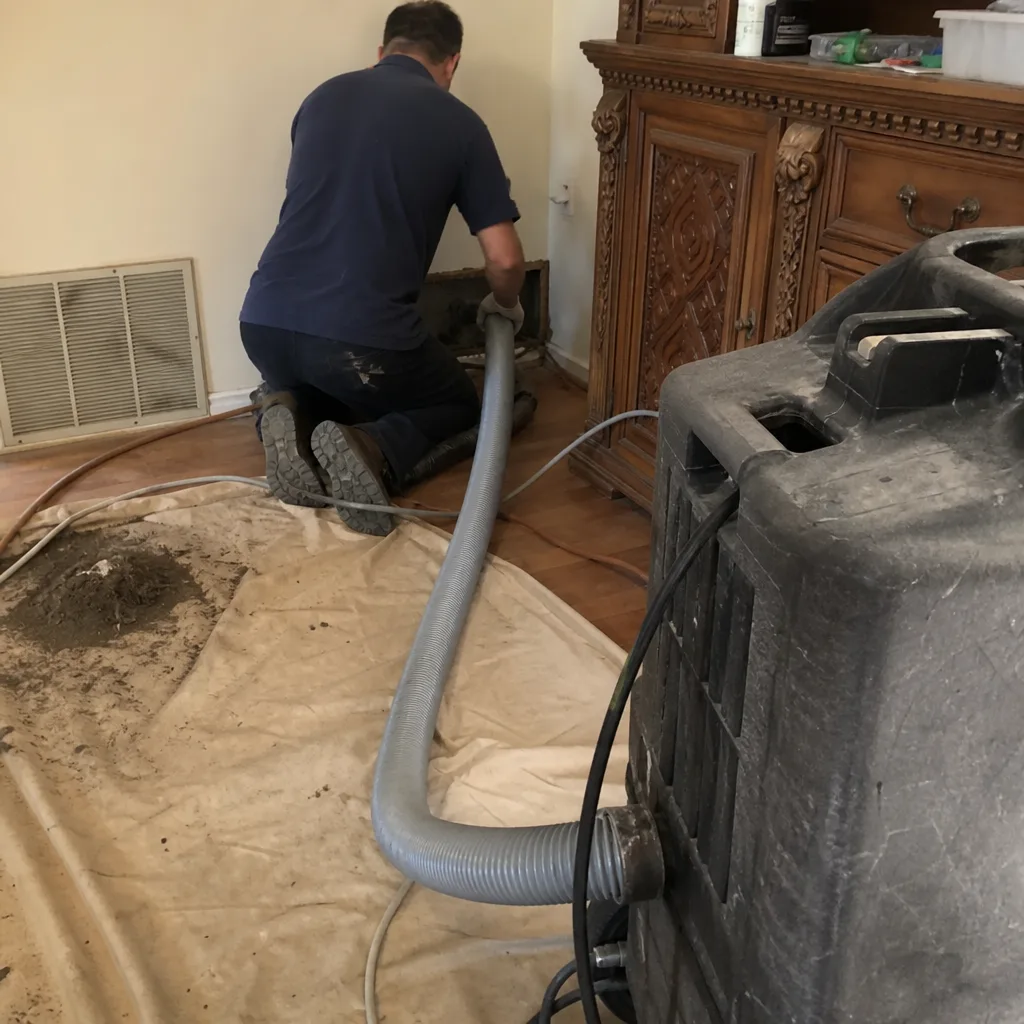
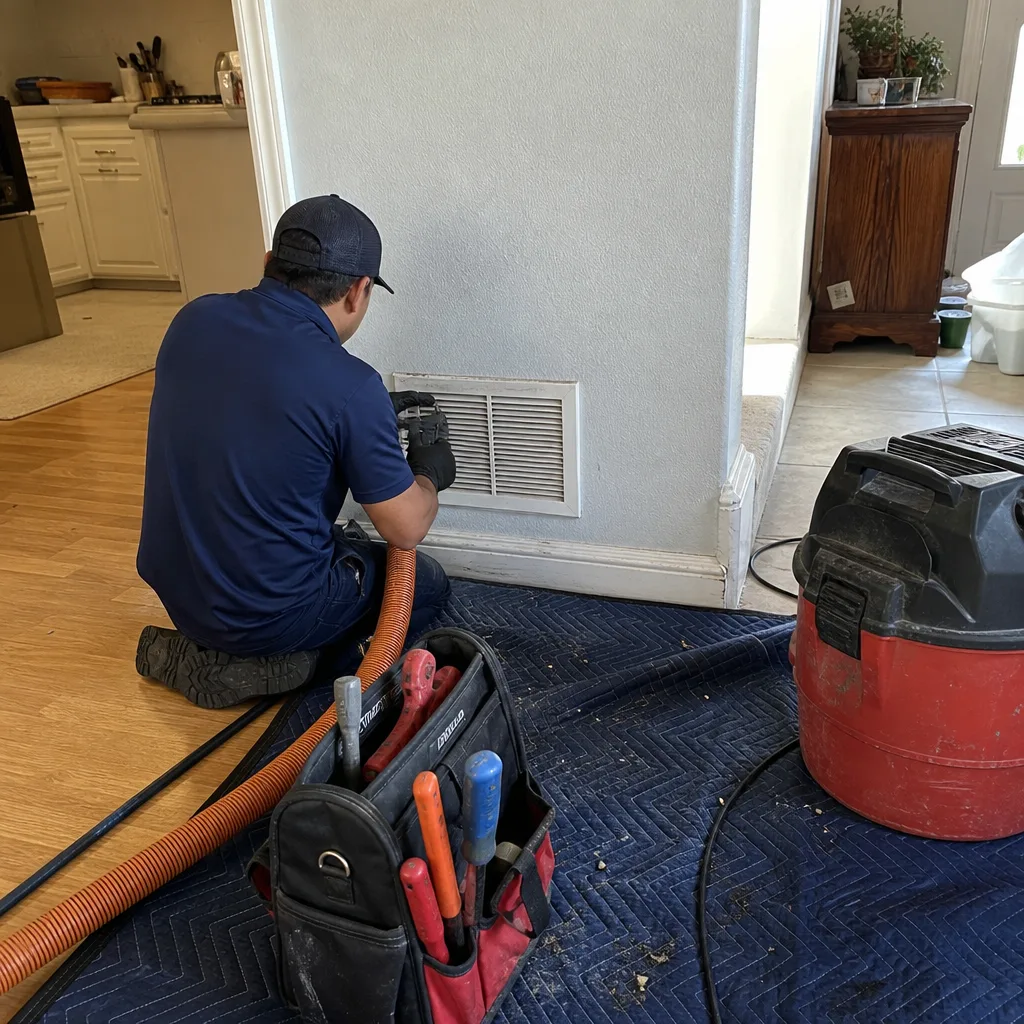
This is why we run negative-air machines during cleaning. The goal is to put the duct system under negative pressure so that as a brush agitation system dislodges material from the duct walls, that material is pulled toward the collection device rather than pushed into the living space. The tools we use, including Rotobrush brush-and-vacuum systems and Nikro HEPA-rated vacuums, are designed to capture at the point of agitation. It’s the same principle professional restoration contractors use when they run Abatement Technologies air filtration devices during a remediation project: contain the particulate, then remove it. Surface cleaning at the register doesn’t do anything about the reservoir of contamination upstream in the branch line and trunk.
How to Distinguish HVAC Equipment Failure from Duct Contamination
This section addresses the most expensive mistake homeowners make: calling an HVAC technician repeatedly for symptoms that originate in the duct system, or conversely, paying for duct cleaning when the real problem is a failing blower motor or a refrigerant leak. Both mistakes cost money without fixing the problem. Here’s a decision framework based on what we see across Tustin calls.
Step 1: Check airflow at the return and at multiple supplies.
Stand near the return grille with the system running. Do you feel a clear pull of air? Then move to each supply register. If airflow is weak everywhere, that points to an equipment issue: a failing blower motor, a slipping belt, or an undersized system. If airflow is strong at some registers and weak at others, the equipment is moving air, and the restriction is in the distribution system. This is the most reliable single diagnostic in the homeowner’s toolkit.
Step 2: Check the temperature split at a strong register.
Measure the temperature of the air at a strong register and at the return grille. A healthy split in cooling mode is roughly 15 to 20 degrees. If the split is good at a strong register, the equipment is doing its job. If a weak register shows a normal split but low volume, the problem is not the unit; it’s a restriction or leak in that branch line. If the split is poor everywhere, the problem is likely equipment-side, or the system is severely undersized for the home.
Step 3: Look at dust return and filter behavior.
If filters load fast but the temperature split and strong-register airflow are normal, the system is moving excess particulate. That points to the ducts as the contaminant source. If the filter stays clean but airflow is weak, you may have a return-side problem: a collapsed return duct, a blocked return grille, or a filter slot that’s pulling air around the filter rather than through it. Our Duct Cleaning Tustin home page walks through the inspection process we use to tell these apart before we recommend any service.
A note on static pressure
Static pressure is the resistance to airflow inside the duct system. A trained technician measures it with a manometer, and the result is the single most informative number about duct health. High static pressure means the blower is working against excessive resistance: dirty or undersized ducts, restrictive duct design, a loaded coil, or a filter with too high a MERV rating for the system. Low static pressure can indicate a major leak or separation in the return side. We mention this because it explains a pattern many Tustin homeowners have experienced: an HVAC tech replaces a blower motor, the system runs better for a month, and then airflow problems return. The motor wasn’t the original failure. It was a symptom of a high-resistance duct system that has never been cleaned or repaired. The equipment fails over time because it’s running against duct restriction, not because the equipment itself is defective.
Common Mistakes to Avoid
- Assuming weak airflow is always a failing blower. A blower motor that runs but moves less air than it should is often working against dirty or collapsed ductwork. Replacing the motor without addressing the restriction produces a temporary fix that fails again within a season. In Tustin, where cooling runs for months, this mistake is the single most common cause of repetitive HVAC service calls that don’t resolve the complaint.
- Treating every musty smell as a dirty system without locating the moisture source. Musty odor is a moisture problem as much as a dust problem. If condensation is forming on duct surfaces, cleaning removes the accumulated material, but the odor will return unless the underlying condensation cause is fixed. In older Tustin homes, a poorly insulated attic duct run is a common culprit.
- Trusting surface cleaning or register vacuuming as a permanent fix. A vacuum at the register removes material within a few inches of the opening. It does not address the trunk line, the plenum, or the branch line behind the opening. If dust returns within days, the reservoir upstream is still releasing material.
- Ignoring one-room-only symptoms. If one bedroom is consistently hot while the others are cool, the branch line serving that room is restricted or leaking. It will not improve on its own, and it will not be fixed by cleaning the rest of the system without inspecting that specific run. This often requires a cleaning pass plus a targeted repair.
- Delaying a call after pest activity. Rodent or bird contamination inside ducts doesn’t stay contained. Every hour the blower runs, it distributes dried waste particles through the supply registers. The longer this goes unaddressed, the more extensive the cleaning and repair scope becomes. If you’ve had a confirmed pest intrusion in your attic or crawl space, the ducts should be inspected even if you haven’t noticed a smell yet.
- Buying a high-MERV filter to treat duct contamination. A denser filter restricts airflow, increases static pressure, and teaches the blower to work harder. It may trap some particles, but it does not remove the source of those particles from the duct walls. In many cases, a high-MERV filter simply causes the system to pull more air around the filter through any gap in the filter slot.
- Skipping duct repair after cleaning. A cleaning pass is not a repair. If the ducts have leaks, separations, or holes from rodents, cleaning removes the contamination but doesn’t fix the openings that will let new contamination in. Homes that need both services do better when both are handled in the same appointment, which is why we built our service line around that combined capability.
When to Call a Professional
Call for a professional inspection when you’ve verified one or more of these conditions: airflow at one or more registers is dramatically weaker than at others, with the temperature split confirmed as normal at a strong register; visible dust returns to the same surfaces within days of wiping them down and filter changes haven’t changed the rate of return; you smell a persistent musty odor that returns within minutes of the blower starting; you’ve had renovation or pest work in the attic or crawl space and are seeing ongoing dust or localized odor; or your filter timeline shows a clear trend of accelerated loading over two consecutive months. None of these conditions resolve themselves, and all of them are diagnosable in a single visit. Duct Cleaning Tustin offers free estimates in Tustin, and we’ll walk through the specific signs you’ve noticed before recommending any work. Call (855) 473-2840 to schedule an assessment.
Frequently Asked Questions
Whole-system air duct cleaning in Tustin typically runs between $400 and $900 for an average single-family home, depending on the number of systems, the accessibility of the ductwork, and whether the job includes add-on work like duct repair or a Dryer Vent Cleaning in Tustin. Homes with multiple zones or extensive post-renovation contamination run higher. Beware of quotes that price per vent, which is a common structure in this industry that encourages low initial quotes and inflated final invoices. We quote one flat price per system based on a walkthrough, and the price is agreed before work starts. Call (855) 473-2840 for an exact quote; estimates are free.
Every 3 to 5 years is the standard interval for most Tustin homes, with three exceptions that shorten the interval: homes with pets that shed heavily, homes that have recently undergone renovation, and homes where anyone has diagnosed allergies or respiratory sensitivity. Homes near heavy pollen loads or in Tustin neighborhoods with mature landscaping may also benefit from a shorter cycle, especially after the spring Santa Ana season.
Cheaper quotes usually come from companies doing surface-level cleaning with portable vacuum equipment, not the negative-air, brush-agitation systems professional restoration contractors use. The difference is in what the equipment captures: a portable shop-style vacuum simply doesn’t generate the negative pressure needed to pull dislodged material from deep within a trunk line, and a brush-only pass without collection pushes more debris into the living space than it removes. The price difference reflects equipment and time, not markup.
We photograph the interior of the duct system before and after cleaning with an inspection camera, and we show you those images on-site before pack-up. You’ll see the trunk line, branch takeoffs, and plenum in both states. Any company doing professional-grade work should be able to produce the same. If the answer to “can I see the before and after photos” is hesitation, that’s a red flag.
For some homes, yes, materially. Dust, pollen, pet dander, and pest debris accumulate in ducts and then cycle through the living space every time the blower runs. Removing that reservoir reduces the particle load in the air, which many allergy-sensitive people notice within days. For homes with persistent allergen concerns, we can also discuss filtration upgrades using AprilAire equipment rated for whole-house allergen capture, which is a different lever than cleaning but often pairs well with it.
If the home has original ductwork that has never been inspected, a camera inspection is a low-cost way to establish a baseline. Ductboard from the 1960s and 1970s in Tustin attics often shows significant degradation: loose fiberglass, collapsed internal surfaces, and boot seals that have failed. Many homeowners discover during inspection that their ducts are in worse condition than their HVAC unit. Addressing that before it produces symptoms is cheaper than reacting after airflow collapses.
The Bottom Line
Duct problems hide in plain sight as HVAC problems, which is why so many Tustin homeowners spend on equipment service calls that never actually fix the complaint. The warning signs are measurable: uneven register velocity, an eight-degree-plus temperature spread on the same zone, a filter that loads in weeks instead of months, dust that returns to the same surfaces within days, and odor profiles that point upstream rather than at the equipment. Once you know what to measure, the diagnosis gets clearer. If your symptoms point to the duct system, the fix is professional-grade cleaning with the right equipment, plus repair of any leaks or separations the cleaning inspection reveals. That’s the combination we deliver at Duct Cleaning Tustin, from the first walkthrough to the after photos. When you’re ready to find out what’s actually in your ducts, call (855) 473-2840 and we’ll schedule a free estimate.
Written by the team at Duct Cleaning Tustin, serving Tustin since 2018.
See the difference
 Before
 After
 Before
 After
 Before
 After