
Last updated November 2, 2026
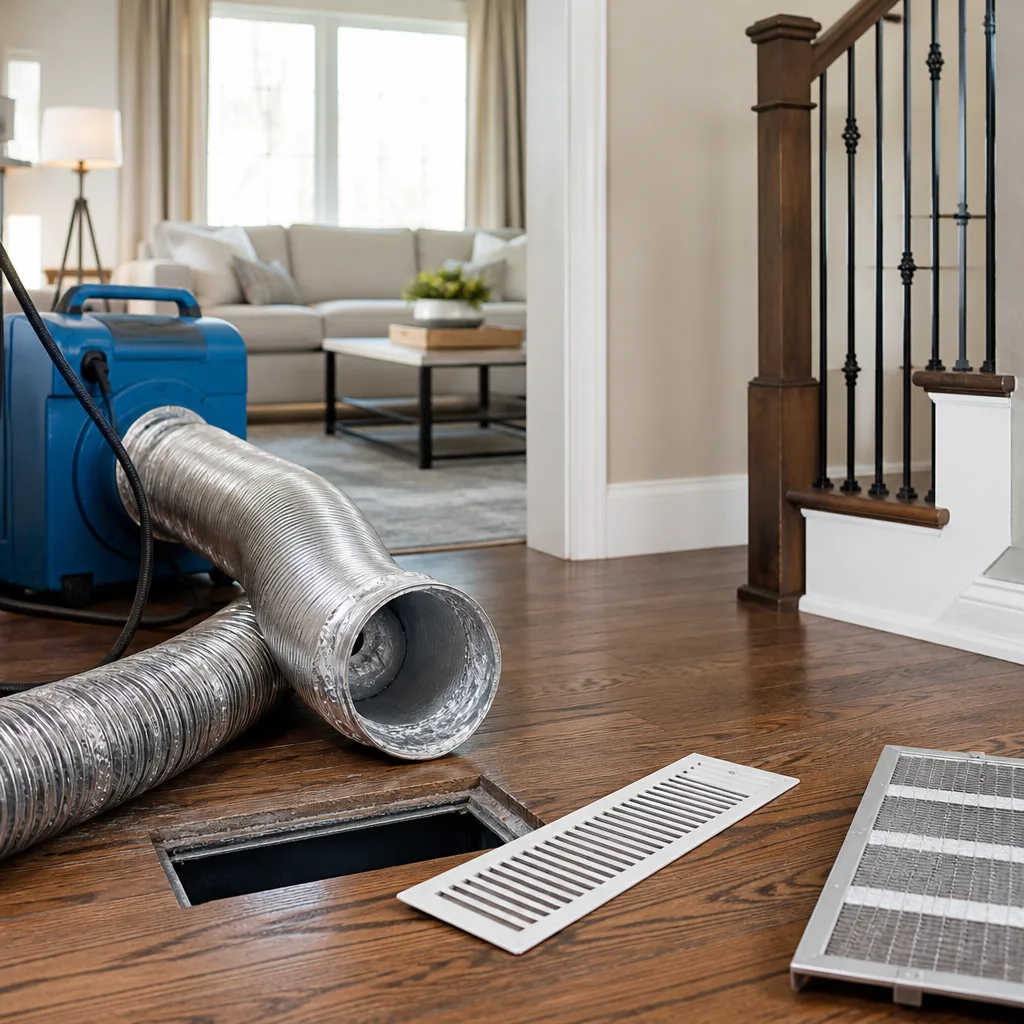 Whole-home duct cleaning
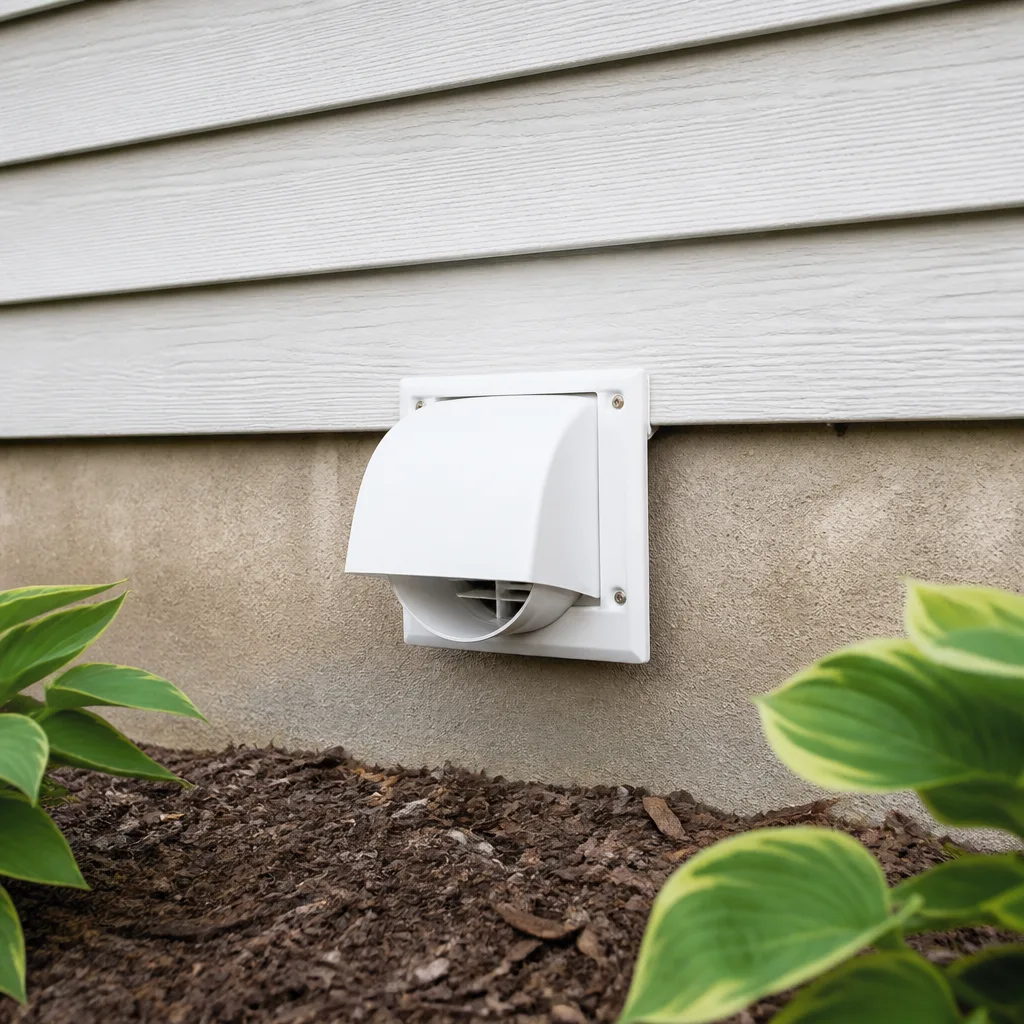 Dryer vent cleaning
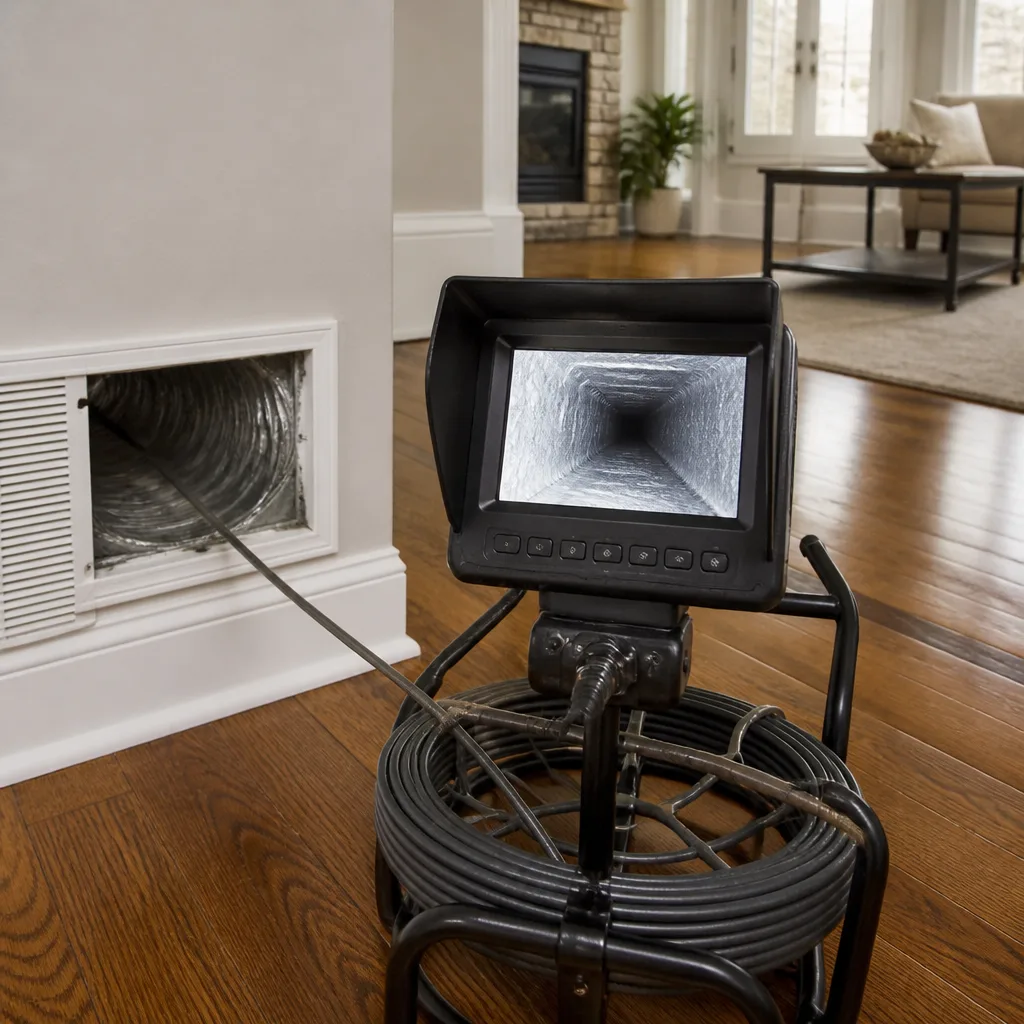 Camera inspection
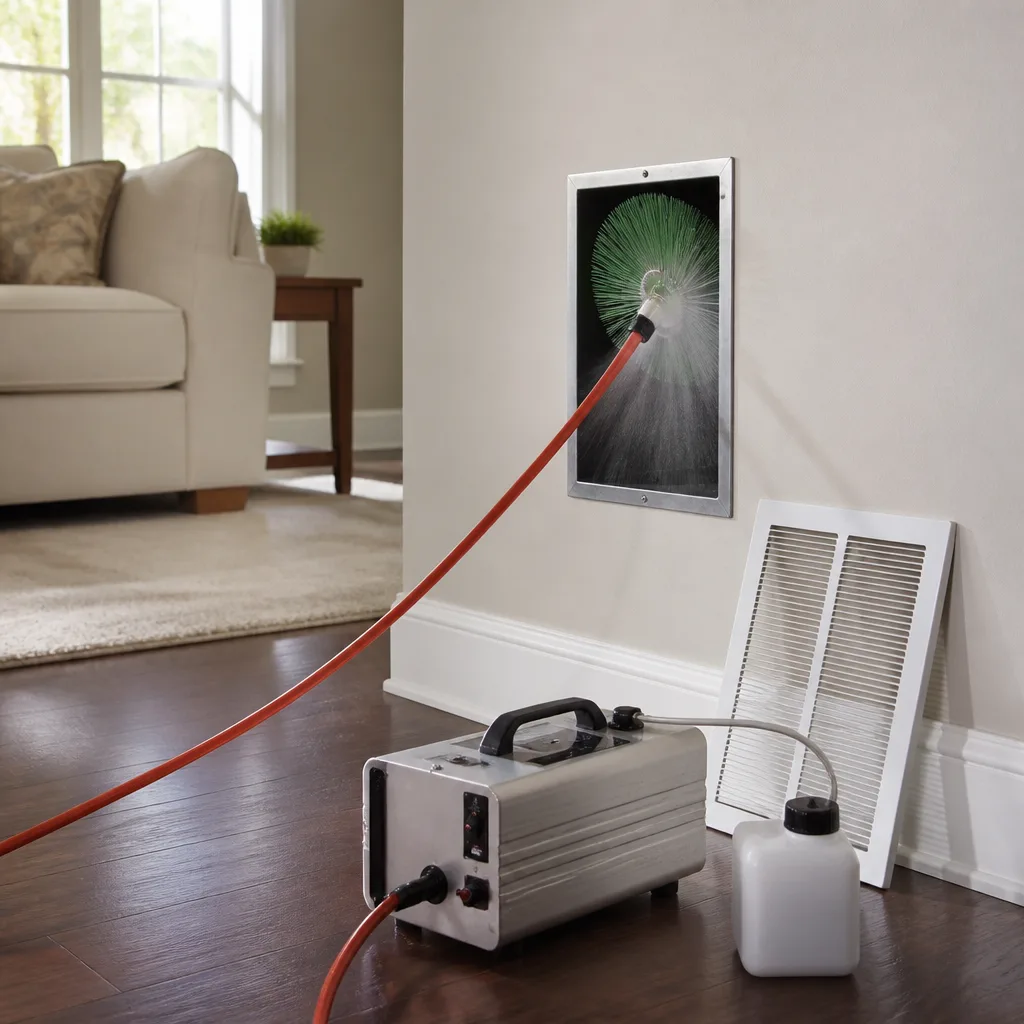 Sanitizing & deodorizing
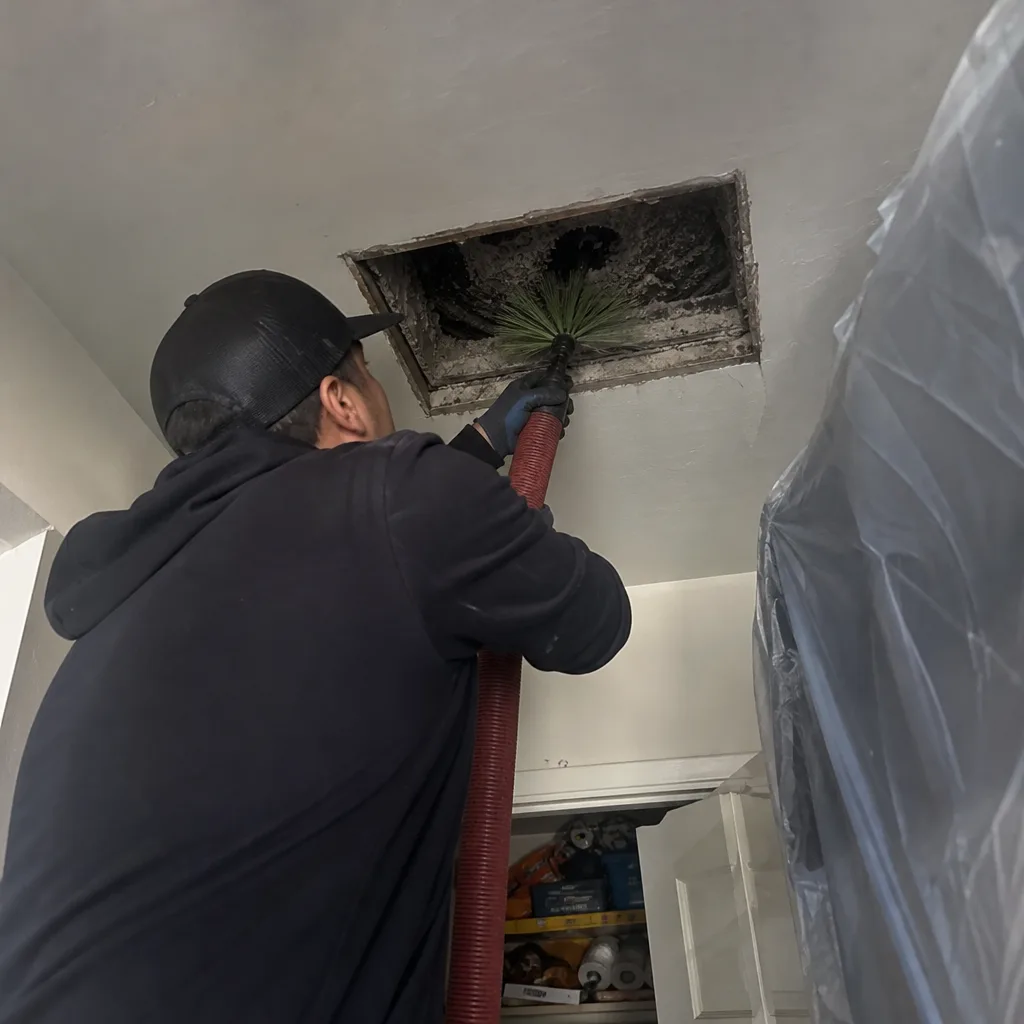
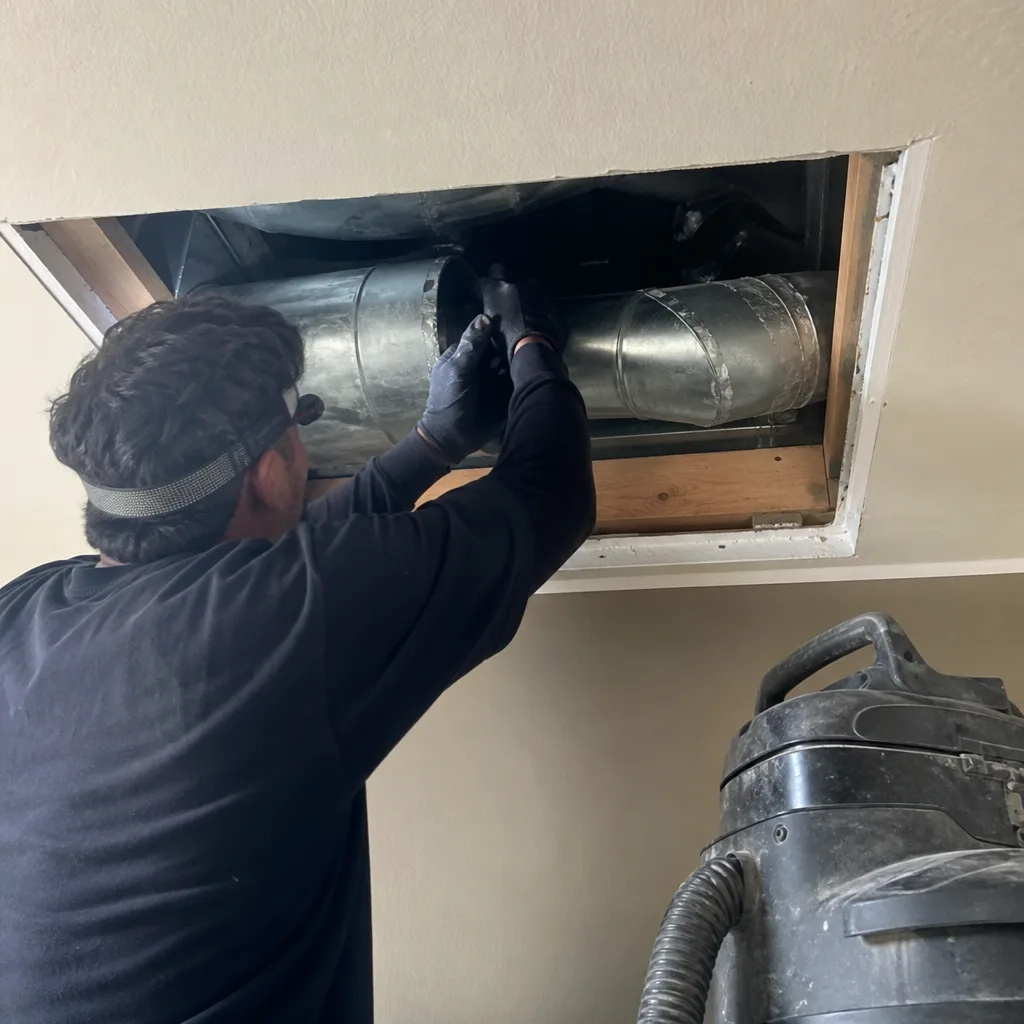
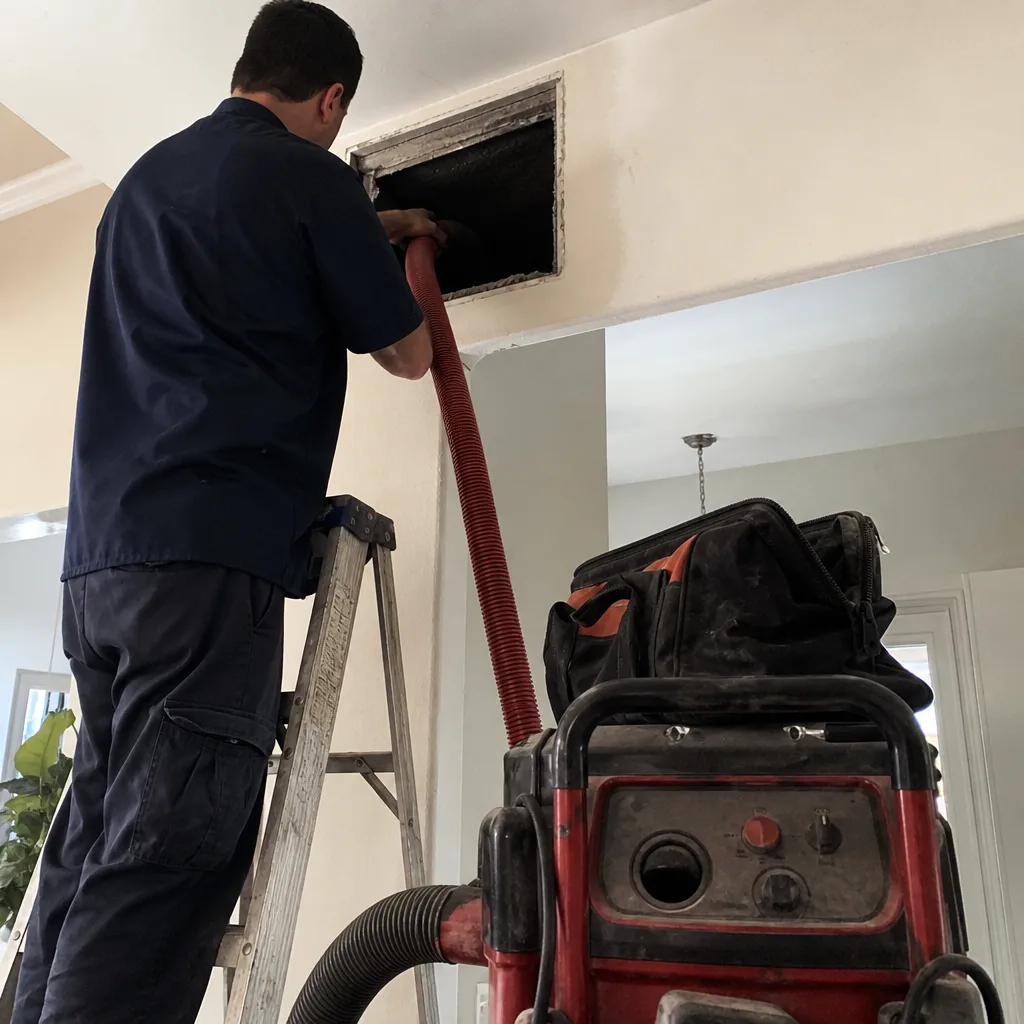
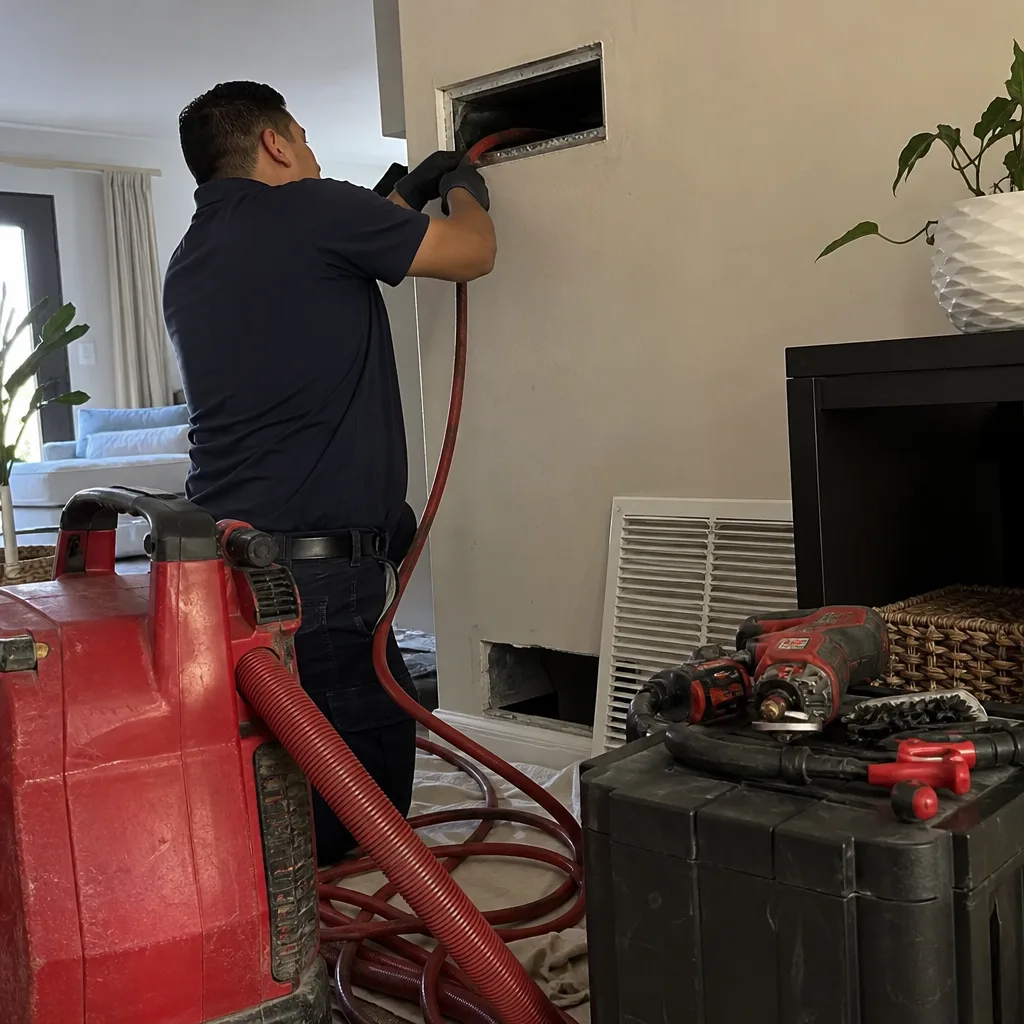
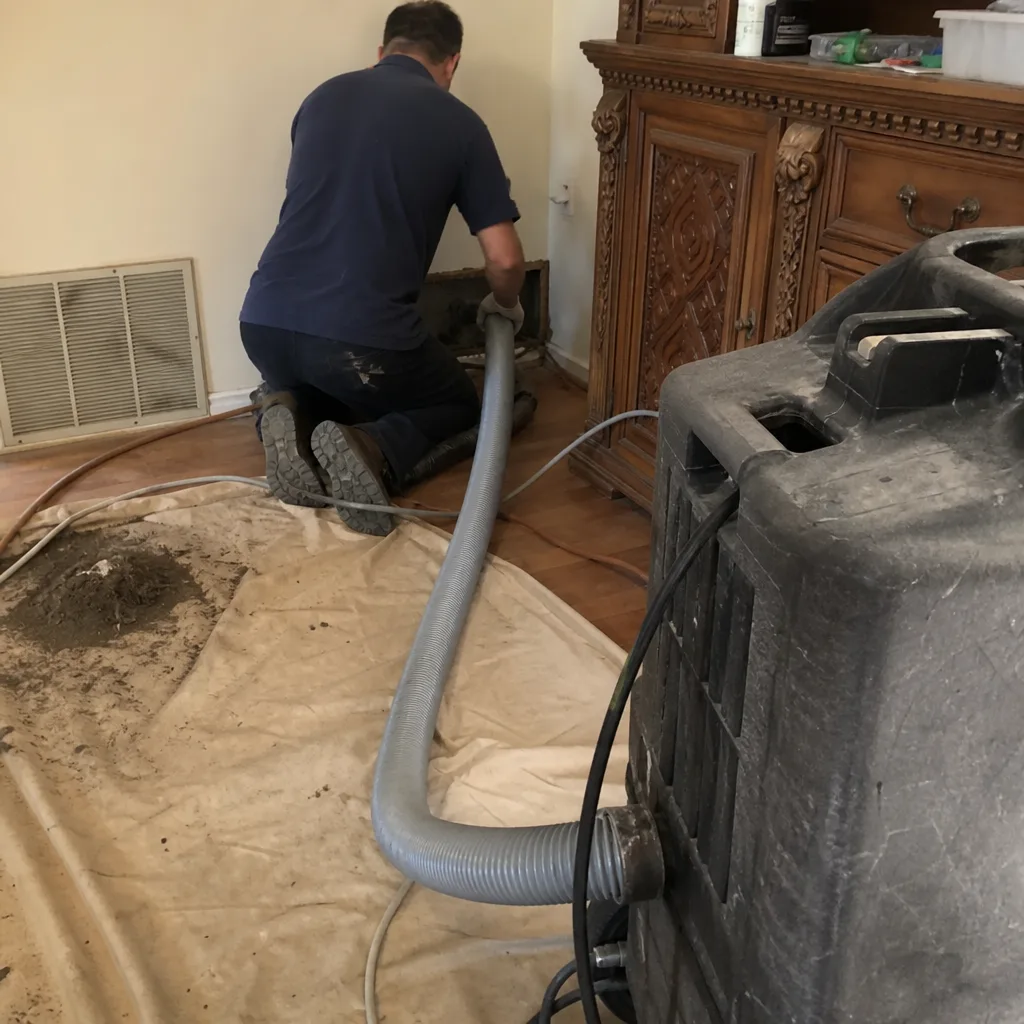
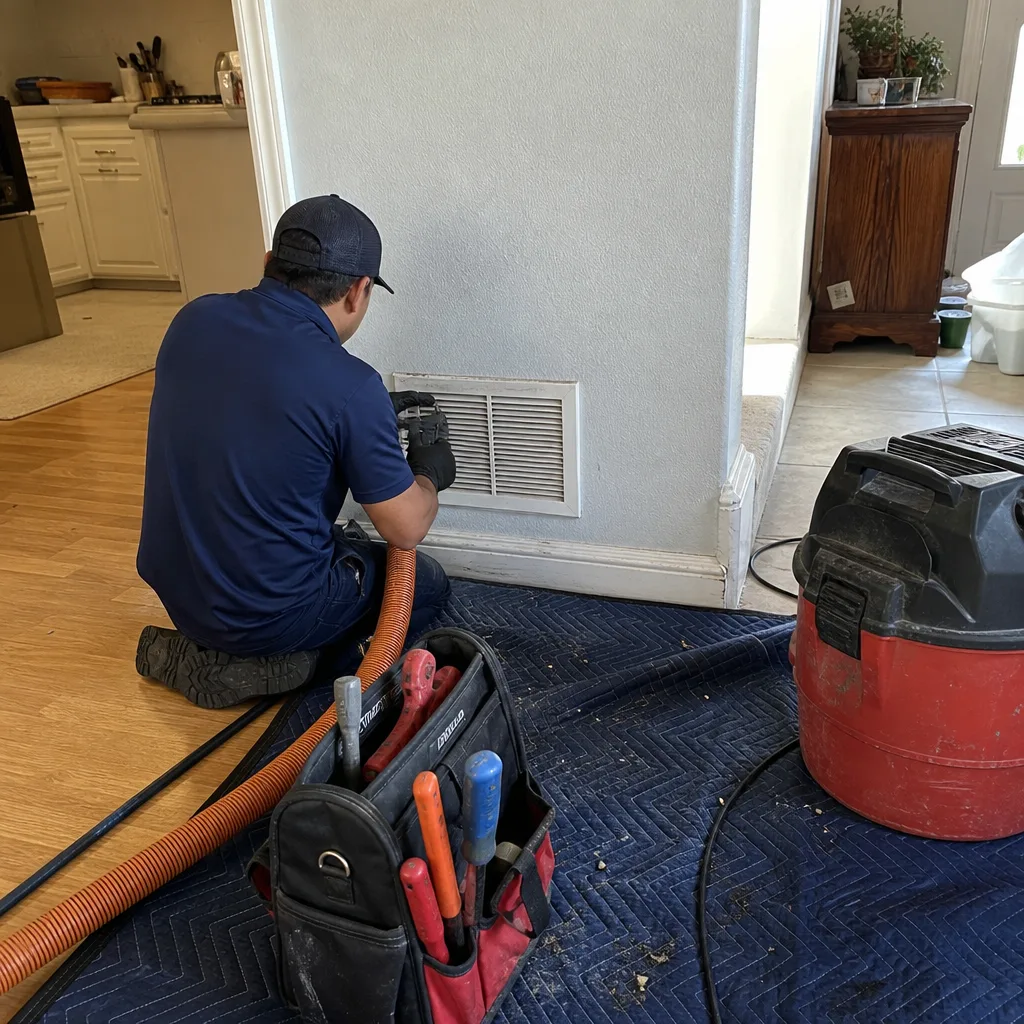
Whole-system duct and dryer vent check with before-and-after photos - you see exactly what came out of your vents
That "$99 whole-house special" is a bait ad - the real number appears once they are in your hallway, or the "clean" is a shop-vac at the register. We photograph the inside of your ducts before and after instead.
DIY vs Professional Air Duct Cleaning: The Tustin Homeowner’s Decision Guide
A standard shop vac moves roughly 50 to 80 cubic feet per minute of air. The extraction systems we run move 160 to 200 CFM under negative pressure, with containment that keeps disturbed debris from spreading through the house. That gap is not a technical footnote. It is the entire difference between freeing debris from your duct walls and actually carrying it out of the building. This guide explains what Tustin homeowners can realistically do themselves, what they should leave alone, and how to tell the difference before spending a dollar on either approach. For more on what professional service involves, see our Air Duct Cleaning services.
Styles & brands we work with
- Whole-home duct cleaning
- Dryer vent cleaning
- Camera inspection
- Sanitizing & deodorizing
Quick Answer
Professional air duct cleaning is the right call for most Tustin homes because consumer vacuums cannot generate the airflow or agitation needed to remove compacted debris from flex duct runs. DIY has a real place, but it is limited to register cleaning, filter replacement, visual inspection, and basic dryer vent clearing. The high-value DIY move is maintenance that stretches the interval between professional cleanings, not a substitute for the cleaning itself. For seasonal timing advice, see our Seasonal Air Duct Cleaning Care for Tustin: Year-Round Homeowner’s Guide.
Table of Contents
- The Physics of Duct Debris Removal
- Why Tustin Duct Systems Are Different
- What You Can Legitimately DIY
- What You Cannot DIY (And Why Attempting It Backfires)
- The Real Cost Comparison: DIY vs Professional
- How DIY Maintenance Extends the Gap Between Professional Visits
- What to Look For in Professional Equipment
- Common Mistakes to Avoid
- When to Call a Professional
- Frequently Asked Questions
- The Bottom Line
The Physics of Duct Debris Removal
Dust does not sit politely on the floor of a duct waiting to be vacuumed. It compacts. It bonds to duct walls with a film of moisture from Tustin’s marine-layer humidity, then gets pressed by every heating and cooling cycle into a layer that resists casual suction. Moving that layer requires two things working together: mechanical agitation to break the debris free from the surface, and enough airflow to carry the loosened particles out of the duct and out of the house.
Here is the problem most homeowners discover the hard way. A shop vac moves air. It does not move enough air to transport loosened debris through a 25-foot flex duct run. What actually happens is this: the vacuum loosens some surface debris, the particles become airborne, and before they reach the vacuum inlet they lose momentum and settle somewhere else in the duct. You have not cleaned the duct. You have redistributed the dust. Months later, that redistributed dust recompacts, and the system looks as bad as it did before the so-called cleaning.
The numbers make this concrete:
- A consumer shop vac: 50 to 80 CFM airflow. Useful for collecting what is already loose. Not adequate for transport through ductwork.
- A professional negative-air extraction system: 160 to 200 CFM airflow, often more. Enough to carry loosened debris through full duct runs and into a HEPA-filtered collection point.
- Mechanical agitation: Needed in both cases. A brush that rotates against the duct wall is what dislodges the compacted layer. Suction alone, even professional suction, does not clean a duct.
Negative pressure matters as much as airflow volume. When a professional system pulls the duct into negative pressure before agitation begins, any dust that becomes airborne during brushing is drawn toward the vacuum rather than pushed out through the vents into your living space. Consumer vacuums do not create this condition. They create localized suction at the hose tip while the rest of the duct remains at normal room pressure. Disturbed dust is free to travel anywhere.
In our experience working on Tustin systems, the debris that refuses to move without professional airflow is usually the stuff that matters most: fine particulate from previous renovation work, pet dander that has cycled through the system hundreds of times, and the fine gray dust that accumulates in flex duct in homes near the 55 and 5 freeway corridors.
Why Tustin Duct Systems Are Different
Tustin homes present a particular set of duct conditions that shape the DIY-versus-professional decision. Understanding what is in your specific ducts starts with understanding how your specific house was built and how it sits in the local climate.
The dominant variable is flex duct. In Tustin’s housing stock, the majority of homes built from the 1980s onward use flexible insulated ducting rather than rigid sheet metal for the branch runs that feed individual rooms. Tracts in Tustin Ranch, Columbus Square, and the neighborhoods east of the 55 were plumbed for forced-air HVAC with flex runs snaked through attics, often with gentle bends and dips. Flex duct has a spiral-wire interior with a plastic liner. That liner develops static-electric charge, and it holds dust more readily than the smooth metal that was common in older construction.
The second variable is attic heat. Tustin sees summer attic temperatures that routinely exceed 130 degrees during August and September afternoons. That heat bakes dust into the flex-duct liner. What starts as loose fibers becomes a semi-adhered film. A homeowner working with a 60-CFM shop vac and a store-bought brush is not breaking that bond. They are polishing the surface of the debris layer while the bound material stays in place.
The third variable is marine-layer humidity. Mornings in Tustin during May and June bring low overcast and elevated relative humidity. That moisture finds its way into attics and duct systems. Dust that would remain loose in a dry climate like Tucson becomes tacky in Tustin. Tacky dust clings. Clinging dust requires agitation to release.
None of this means every Tustin home needs professional cleaning on a fixed schedule. It means that when cleaning does become necessary, the cleaning method needs to be matched to the actual conditions inside the ducts. A homeowner in a tract home with original flex duct from 1995 who has never had the system professionally cleaned is not facing a light dusting. They are facing two decades of compacted, baked-in debris.
For homeowners who want a deeper understanding of what a professional cleaning actually involves in this area, our guide to Air Duct Cleaning in Tustin walks through the full process and what to expect from a service visit.
What You Can Legitimately DIY
The honest answer to the DIY question is not that homeowners can do nothing. It is that the DIY tasks worth doing are narrower than most marketing suggests, and they deliver the most value when they are treated as maintenance rather than as cleaning. These are the tasks that are safe, effective, and within reach of a homeowner with standard tools.
- Register and grille cleaning. Remove the vent covers throughout the house, wash them in warm soapy water, let them dry, and reinstall. This takes an hour and removes visible dust and grime that sits at the point where air leaves the system. A toothbrush or sponge gets into the louvers. This is true cleaning, and it improves airflow through the registers immediately.
- Filter replacement on a real schedule. In Tustin’s climate, a one-inch fiberglass or pleated filter should be changed every 30 to 90 days depending on household size, pets, and season. Write the installation date on the filter frame with a permanent marker. A dirty filter increases the pressure drop across the system, which reduces airflow and makes the system work harder. Replacing the filter is the single highest-impact maintenance task a homeowner can do. Period.
- Visual inspection at access points. Pop off a register in a couple of rooms, shine a bright flashlight into the opening, and look. Take a photo with your phone. This does not show you the entire system, nothing can show a homeowner the entire system, but it tells you whether visible dust is accumulating on the duct surfaces near the register. Documenting what you see gives you a baseline and helps you decide when to call in a professional.
- Dryer vent clearing within reach. If your dryer vents through an exterior wall and you can reach the termination point with a screwdriver and a short brush, clearing the visible lint at the opening is a legitimate safety task. You can also pull the dryer out and vacuum behind it. What you cannot do safely from inside the house is clear a long, multi-bend dryer vent run. That is a job for a dedicated Dryer Vent Cleaning in Tustin service with the right rotating brush and collection equipment.
These tasks share a common thread. They address surfaces you can see and reach, with tools you already own, without risking damage to the duct system itself. That is the honest boundary of DIY air duct work.
What You Cannot DIY (And Why Attempting It Backfires)
There must be no false modesty here. The tasks below are not just hard for a homeowner. Attempting them usually makes the situation worse, and in some cases it makes a later professional cleaning more expensive.
Compacted debris in flex duct runs
We described the physics earlier. The practical version is this: when a homeowner runs a shop vac into a flex duct and agitates the debris with a brush on a drill, they loosen material they cannot capture. The loosened debris that does not settle back into the duct gets blown into the house through the registers. That is the opposite of progress. A professional Air Duct Repair in Tustin technician can also inspect those same flex runs for leaks while the system is open, a diagnosis that home-grade tools simply cannot perform.
Mold presence
If you see anything that looks like mold growth on the interior surfaces visible near your registers, stop. Do not vacuum it. Do not brush it. Disturbing mold with a consumer vacuum launches spores into the air you breathe, and a consumer vacuum is not equipped to capture them. Mold in a duct system is a professional containment and removal scenario. The duct surfaces themselves may need repair or replacement. This is outside DIY territory entirely.
Post-renovation particulate
Tustin has a steady churn of remodels and additions in neighborhoods like the areas around Old Town and the hillside communities. After a renovation, ducts fill with drywall dust, sawdust, and miscellaneous construction debris. Drywall dust is ultrafine and stubborn. It bypasses household vacuums and it embeds in filter media. Removing it properly requires professional-grade HEPA extraction. Vacuums that do not carry HEPA filtration simply re-emit the finest particles back into the room.
Pest debris
Rodents and insects find their way into Tustin attics and occasionally into duct runs. Their debris is a biohazard, not a dust problem. Dislodging it with a homeowner vacuum spreads those contaminants. This requires professional removal, followed by an assessment of whether the affected duct sections need replacement rather than cleaning.
What these conditions share is that they involve debris that is bonded, hazardous, or too fine for consumer equipment. A failed attempt leaves the homeowner with the same problem they started with, plus the added complication of debris that has been stirred up and spread around.
The Real Cost Comparison: DIY vs Professional
Here you get the numbers, and here you should pay attention to what the numbers actually include. The DIY-versus-professional cost comparison is misleading if it stops at supply costs versus service fees. What matters is the outcome cost.
If a homeowner in Tustin buys an entry-level shop vac for $70, a brush kit for $25, and a set of register cleaning tools for $30, they are in for about $125 plus their time. If that homeowner spends a Saturday on the work and the result is clean registers, a changed filter, and no disturbance to the deeper duct system, that $125 bought exactly what it should have. That is a maintenance expense and it is a reasonable one.
If the same homeowner pushes the shop vac into the duct branch lines and stirs up compacted debris that then recirculates through the house, the real cost looks different. Now the professional cleaning must not only remove the original compacted debris but also capture the newly airborne material that has settled across surfaces in the home. The system is dirtier than before. The professional visit still costs the same flat system price it would have cost originally, but the homeowner has added a weekend of labor, $125 in equipment, and several weeks of breathing loosened dust.
The worse version: DIY agitation damages a flex duct connection or punctures the liner. Flex duct replacement is not a cleaning conversation, it is a repair. The labor to access and replace a damaged flex run in a Tustin attic runs significantly more than the cost of a professional cleaning itself.
The realistic math is simple. Professional cleaning of a typical Tustin home’s duct system is priced per system, not per vent, and the total has not changed because someone attempted DIY first. The variable is what condition the system is in when the professional arrives. A disturbed system takes more work to properly capture. A maintained system cleans faster.
We recommend asking about whole-system pricing before any service is scheduled. The honest providers in this industry quote one flat price per system that is agreed before work starts. That gives you the real number to compare against your $125 worth of DIY equipment. If your ducts actually need cleaning, you will see quickly whether the DIY savings was real or imaginary.
How DIY Maintenance Extends the Gap Between Professional Visits
The smart way to think about DIY work is not as a replacement for professional cleaning. It is as a way to make professional cleanings less frequent. Here is the maintenance routine we suggest for Tustin homeowners who want to minimize how often the system needs deep cleaning.
- Change filters on schedule, no exceptions. Most Tustin households need replacement every 60 to 90 days during mild months and more often during high-use summer and winter periods. Homes with pets or near busy road corridors should shorten that interval. A clean filter is the single biggest determinant of how quickly dust accumulates downstream in the duct runs.
- Clean registers and grilles quarterly. When register covers are clean, the air flowing into your rooms carries less accumulated dust from the vent opening. This is a 30-minute task.
- Clear the dryer vent termination twice a year. Trapped lint at the exterior vent creates backpressure that pushes moisture and lint back into the duct run. A five-minute exterior clearing keeps the buildup from setting.
- Vacuum accessible return-air openings. The return side of the system is where open air gets pulled in before filtration. Dust accumulates there quickly. If you can see buildup at the return grille, clear it before it works its way into the return duct.
- Keep a visual record. Once a year, take comparison photos at your registers. If the visible accumulation is getting worse despite filter discipline, the deeper system is the source. That is the signal to schedule a professional visit, not to buy a stronger vacuum.
None of this substitutes for professional cleaning of the full duct system. What it does is buy time between professional visits. In a Tustin home with disciplined filter changes and register cleaning, a professional cleaning might be a once-every-several-years event rather than an annual one. That is where DIY actually saves money.
What to Look For in Professional Equipment
This is a guide about the DIY decision, and part of making that decision honestly is knowing what the professional alternative actually involves. The phrase professional-grade gets thrown around loosely. For duct cleaning, it describes specific capabilities.
The industry standard for mechanical agitation is a brush system that rotates inside the duct while the vacuum runs. We run Rotobrush equipment for this reason. The brush head spins against the duct walls, breaking debris free while the integrated vacuum extracts it. This combination of agitation and extraction is what removes the compacted layer, and it is the reason a Rotobrush system produces different results than a vacuum hose poked into a duct opening.
HEPA filtration is the second capability that matters. A professional extraction system must capture what it removes. Nikro equipment with HEPA-rated filtration traps particulate instead of venting it back into the home. When we clean a duct system in Tustin, the air leaving our equipment is cleaner than the air entering it. That is not true of consumer vacuums, which exhaust fine particulate through their filters and back into the room.
The third capability is containment. For systems with significant contamination, the approach used in restoration and remediation makes sense: negative-air containment that keeps disturbed dust from migrating into the living space during cleaning. Our familiarity with Abatement Technologies equipment, the same class of air-filtration devices used in professional mold and remediation work, informs how we set up a job site. Dust stays in the duct. It does not relocate to the sofa.
When you are evaluating professional options, ask what equipment the contractor runs. The name on the machine matters less than the capability it represents. A rotating-brush agitation system is not a consumer vacuum with a brush attachment. A HEPA extraction unit is not a shop vac with a nicer filter. If a contractor cannot tell you what equipment they use and why, that tells you something too.
The right equipment also changes what else can be done in the same visit. A company that runs professional-grade duct-cleaning equipment is often equipped for Air Duct Repair during the same appointment. Finding a leak while the system is open and sealing it on the spot is far more convenient than scheduling a second contractor for a second visit. That capability, cleaning to repair in one visit, is one of the reasons the equipment conversation matters.
Common Mistakes to Avoid
- Using a leaf blower on a duct opening. We should not have to say this, but we do. A leaf blower creates massive static pressure and launches debris back through the registers in a cloud. This is the fastest way to make an entire house dirtier in 30 seconds.
- Buying a longer vacuum hose instead of the right tool. A shop vac with a 30-foot hose still moves 50 to 80 CFM. Adding distance reduces flow. You cannot hose-length your way out of a physics problem.
- Believing the $79 whole-house coupon. The bait-and-switch duct-cleaning coupon is a fixture of this industry. The advertised price gets the van in the driveway. The real number comes later. Look for a company that quotes one flat price per system before work starts. If the advertised price is below what a legitimate cleaning costs to perform, it is not the real price.
- Hiring a generalist handyman with a vacuum attachment. Duct cleaning is a specialty. The person who fixes your fence and patches drywall is not the person you want inside your duct system. Ask what equipment they run and what training they have.
- Skipping the filter because the duct cleaning will handle it. A professional cleaning is not a substitute for filter discipline. If you go back to neglected filters after a cleaning, the system reaccumulates the same debris in the same way. Maintenance and cleaning are two different functions.
- Ignoring visible damage because the system is old. A disconnected flex run or a crushed duct section is not a cleaning problem. It is an airflow and contamination problem. Have it assessed. The longer a damaged section stays in place, the more debris it introduces into the rest of the system.
When to Call a Professional
You call a professional when the job is no longer about maintenance. If visible dust at your registers returns within weeks of cleaning them, the source is inside the duct system. If you have completed a renovation and drywall dust covers every register despite filter changes, the system needs HEPA extraction. If you see mold-like growth, pest evidence, or a smell that you cannot locate, stop investigating and call someone who can assess the system properly. If your dryer is taking longer to dry clothes, the vent run is obstructed beyond what an exterior clearing can reach. If you have never had a professional cleaning and your home is twenty years old, the built-up layer inside the flex duct is not something your $125 DIY kit will address. Duct Cleaning Tustin offers free estimates in Tustin, call (855) 473-2840 to find out what your system actually needs.
Frequently Asked Questions
Professional air duct cleaning in Tustin is typically priced per system, with whole-system pricing for an average single-family home generally falling in the range of $350 to $650 depending on system size, number of returns, and contamination level. The key is to ask for one flat price per system agreed before work starts, not a per-vent figure that can change mid-job. Call (855) 473-2840 for an exact quote, estimates are free.
A shop vac cannot clean air ducts in any meaningful sense because it generates 50 to 80 CFM, which is not enough airflow to transport loosened debris through a duct run to the vacuum inlet. The result is that debris gets stirred up and redistributed rather than removed. Use the shop vac for registers, return grilles, and the space behind the dryer. Leave the duct interior to equipment that moves air at professional volume.
Most Tustin homes need professional air duct cleaning every 3 to 5 years, with homes that have pets, smokers, or recent renovation work falling on the shorter end of that range. Homes near busy road corridors like the 55 and 5 may also accumulate fine particulate faster and benefit from more frequent cleaning. Maintenance habits such as regular filter replacement are what determine how far you can stretch that interval safely.
DIY air duct cleaning is safe for tasks that do not involve disturbing bonded debris inside the duct runs, such as register cleaning and filter replacement. It becomes unsafe when a homeowner attempts to agitate and extract debris from inside the duct system, especially flex duct, because without professional filtration the loosened particulate recirculates into the living space. If you see mold-like growth or pest evidence, do not DIY. Call a professional.
Cheap duct cleaning quotes usually come from companies using portable vacuums rather than truck-mounted or high-CFM extraction systems, and the low advertised price often does not survive contact with the actual service visit. The low number gets the appointment booked. The real cost appears after the technician evaluates the system. Ask any company to confirm one flat price per system before work starts, and if they will not confirm it, treat the quote as unreliable. Call (855) 473-2840 for a free, honest estimate of what your system actually needs.
The best DIY air duct cleaning tool is a good-quality pleated furnace filter, changed on schedule. That tool does more for system cleanliness than any vacuum attachment or brush kit, because it prevents debris from entering the duct runs in the first place. A secondary pick is a set of register-cleaning brushes and warm soapy water for the vent covers. For everything deeper, the right tool belongs to a professional.
The Bottom Line
The DIY-versus-professional decision comes down to one question: are you maintaining the areas you can see and reach, or are you attempting to clean the parts of the system you cannot? Register cleaning, filter discipline, and dryer-vent clearing are legitimate homeowner work that extends the life of a professional cleaning. Anything beyond those tasks crosses into territory where consumer equipment is not just inadequate but counterproductive. In Tustin, where flex duct, attic heat, and marine-layer humidity combine to produce a specific kind of compacted duct debris, the gap between shop-vac suction and professional-grade negative pressure is the gap between stirring dust up and actually removing it. For more guides & resources on keeping your system clean, visit our blog. For a free estimate and an honest assessment of what your duct system needs, call Duct Cleaning Tustin at (855) 473-2840.
Written by the team at Duct Cleaning Tustin, serving Tustin since 2018.
See the difference
 Before
 After
 Before
 After
 Before
 After